
This article is about which countries produce ATP top-100 players most efficiently — and why the raw country count table tells you almost nothing on its own.
The United States leads the ATP top 100 with 17 players — more than any other nation. France is second with 12. Argentina third with 9. That’s the conventional table. But it tells you almost nothing about which countries are actually producing elite tennis talent efficiently.
Adjust for population, and the table looks completely different.
The raw numbers first
Here’s where the current ATP top 100 players come from, by absolute count:
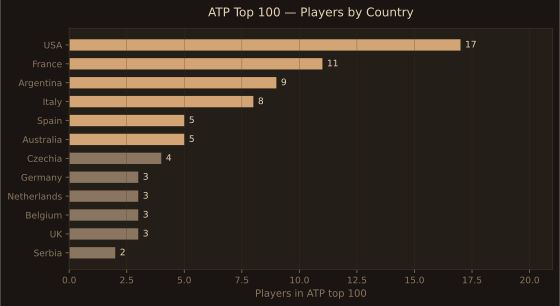
The USA’s dominance looks overwhelming. But the US has 335 million people. Serbia has 6.8 million, and it has 3 players in the top 100 — Djokovic being one of them.
Per capita: the real picture
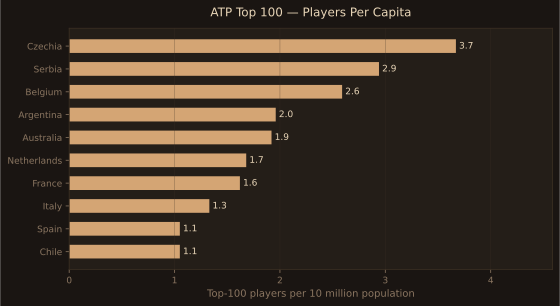
We took every country with at least 2 top-100 players and divided by population (in units of 10 million). Population figures are World Bank 2024 estimates — not perfect, but consistent enough for comparison:
| Country | Players | Per 10M population |
|---|---|---|
| Serbia | 3 | 4.4 |
| Czechia | 4 | 3.7 |
| Belgium | 3 | 2.6 |
| Australia | 6 | 2.3 |
| Hungary | 2 | 2.1 |
| Argentina | 9 | 2.0 |
| France | 12 | 1.8 |
| Netherlands | 2 | 1.1 |
| Spain | 7 | 1.5 |
| Kazakhstan | 2 | 1.0 |
| Canada | 3 | 0.8 |
| USA | 17 | 0.5 |
| Poland | 2 | 0.5 |
| Germany | 3 | 0.4 |
| Great Britain | 2 | 0.3 |
Czechia leads among larger nations. A country of 10.9 million produces 4 top-100 players — the equivalent of the US producing 123 players from its population. Serbia, despite having barely 7 million people, now produces three — Djokovic, Kecmanovic, and Medjedovic.
Belgium — 11 million people — has 3. Australia, with six players from 26 million people, punches well above its weight.
Spain sits lower on the per-capita table than you might expect — seven players including the world #2 (Alcaraz), from a population of 47 million. On a per-capita basis, Spain still outperforms both Germany and Great Britain.
The USA, by this measure, ranks around 14th. Germany and Great Britain are near the bottom.
Method to the madness
We counted players by the country field in our PostgreSQL database — i.e. the flag they represent on tour, not birthplace. That’s a deliberate choice for this piece (birthplace tells a different story; we wrote about that separately). Four players in the top 100 have blank country fields in ATP profiles — Medvedev, Rublev, Khachanov, and Struff — and are excluded from the country totals above.
Why small nations overperform
A few factors explain it:
National identity and tennis culture. In Serbia and the Czech Republic, tennis is a genuinely popular participation sport with deep roots. A smaller talent pool focusing intensely on one sport tends to produce outliers more efficiently than a large country where the best athletes are distributed across many sports.
Academy investment relative to population. Belgium produced two of the greatest players in women’s tennis history — Clijsters and Henin — through a federation that has invested heavily in talent development relative to its size. The Czech Republic has built a network of elite academies that consistently produce players well above what its population alone would suggest.
Selection pressure. In a small country, the very best junior players are identified and invested in early, because there are fewer of them to track. In the US, a genuinely talented 14-year-old can go unnoticed for years in a system with thousands of ranked juniors.
The USA paradox
17 players in the top 100 is impressive in absolute terms — the most of any nation. But relative to a country with the resources, infrastructure, and population of the United States, it’s arguably underperformance. The USTA spends more on tennis development than almost any federation in the world and produces fewer players per capita than Argentina, which operates on a fraction of the budget.
This is a pattern seen in other sports: the US dominates globally in absolute terms but consistently underperforms on a per-capita basis in sports where small European and South American nations have cultivated deep cultural attachment.
Built from our database
Every player count in this analysis came from our live ATP rankings database, queried directly from 2,233 tracked players.
If you’re building a sports analytics product that needs current player-country data, the Baseline Rank API provides structured ATP ranking data updated weekly.
Player data sourced from the Baseline Rank rankings database, June 2026. Population figures from World Bank 2024.